
Official Definition:
Event-Driven Architecture (EDA) is a software design pattern in which decoupled components communicate through events — discrete messages that signal a change in state. These events are typically produced, transmitted, detected, and consumed asynchronously.
Let’s Get to It
Imagine a restaurant where orders are placed at the counter. Instead of one chef taking every request in order, different chefs are notified only when a dish relevant to them is ordered. That’s how Event-Driven Architecture works in tech!
In EDA, systems don’t constantly check for updates (like traditional polling); they listen and react. Components emit “events” (e.g., PaymentCompleted, InventoryUpdated), and other services respond to those events independently. This allows systems to be more responsive, resilient, and scalable.
Think of a music band: when the drummer speeds up, the rest adjust instantly. That’s an event-driven jam session — decentralized yet harmonious.
How It Helps
When to Use EDA:
- When system components need to be decoupled and operate independently
- When you expect high-volume, real-time data flow (e.g., payments, fraud detection, sensor data)
- When scalability and fault isolation are key (e.g., microservices, cloud-native apps)
- For audit logs, analytics pipelines, or reactive notification systems
Common Patterns in EDA:
- Event Notification: Event is a signal, no payload expected (e.g., “new user registered”)
- Event-Carried State Transfer: Event includes data to act on (e.g., “order placed with full details”)
- Event Sourcing: System state built from a sequence of past events
- CQRS (Command Query Responsibility Segregation): Separates read and write models, often combined with EDA
Pitfalls to Watch Out For:
- Lack of observability – debugging can become a nightmare without tracing
- Event schema drift – versioning events must be handled carefully
- Harder to manage consistency – requires eventual consistency mindset
- Overuse – not every interaction needs to be event-driven; sometimes simple RPC is better
Comparison: EDA vs Traditional Request-Driven
| Aspect | Request-Driven | Event-Driven |
|---|---|---|
| Communication | Synchronous | Asynchronous |
| Coupling | Tightly coupled | Loosely coupled |
| Scalability | Limited by bottlenecks | Highly scalable |
| Error handling | Direct response codes | Dead letter queues, retries |
| Complexity | Simpler to trace | Harder to debug |
| Latency | Immediate but can block | Responsive but eventually consistent |
Pros:
- Scales independently and elastically
- Improves system responsiveness
- Great for microservices and distributed systems
- Enables real-time analytics and alerting
Cons:
- Complex debugging and tracing
- Event schema versioning can be tricky
- Harder to reason about state without tooling
In Essence
- Event-Driven Architecture decouples systems using asynchronous messaging
- Helps scale microservices and backend systems efficiently
- Ideal for real-time processing (e.g., payments, fraud detection, notifications)
- Use tools like Apache Kafka, RabbitMQ, AWS EventBridge, or Azure Event Grid
- Requires good observability and schema governance to maintain stability
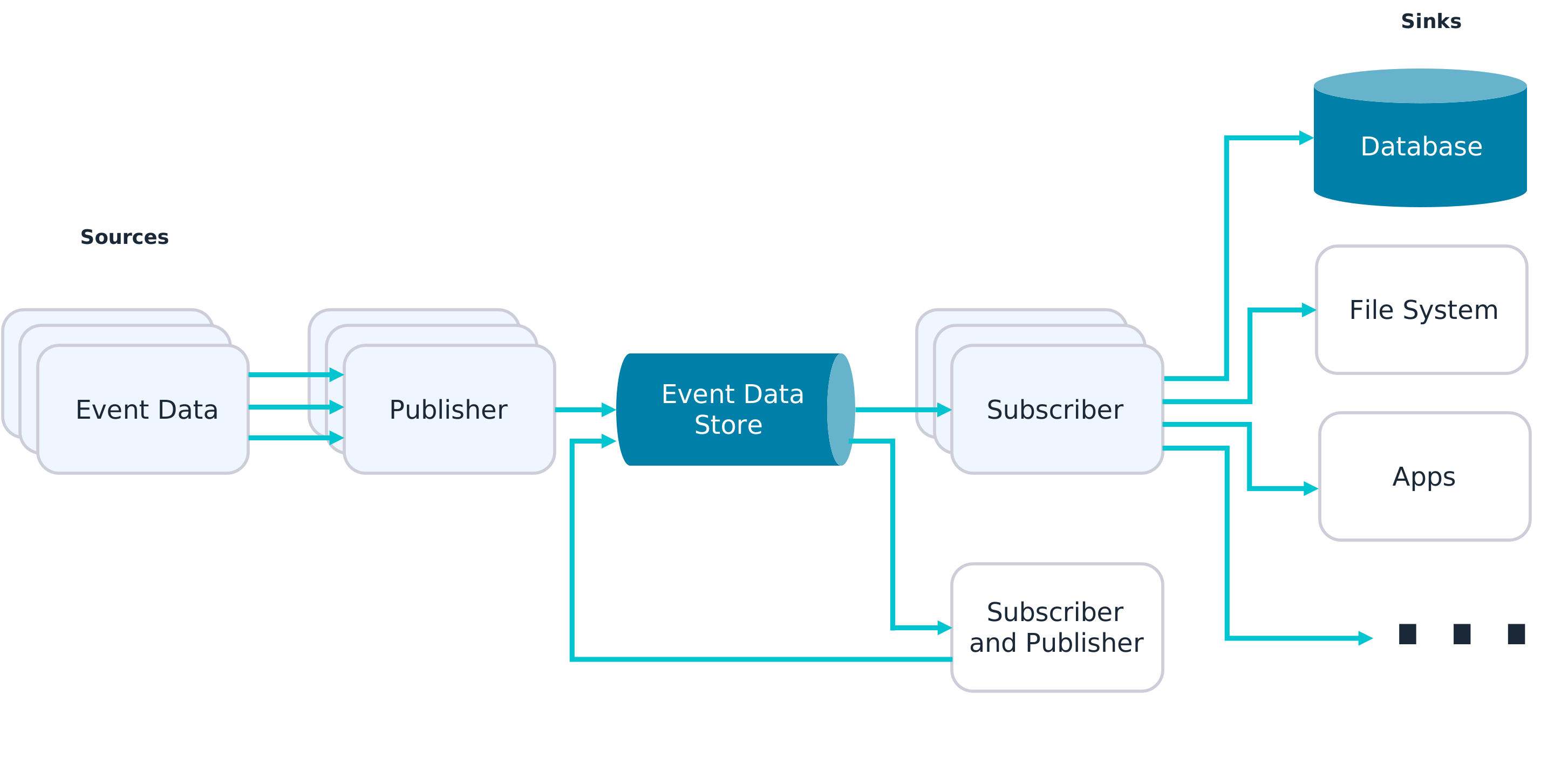
Visual Diagram:
On a Funny Note
“If microservices are the band members, then events are the rhythm they follow — always in sync, even when no one’s conducting.”
 Muses of a Reticent Techie
Leave a comment